
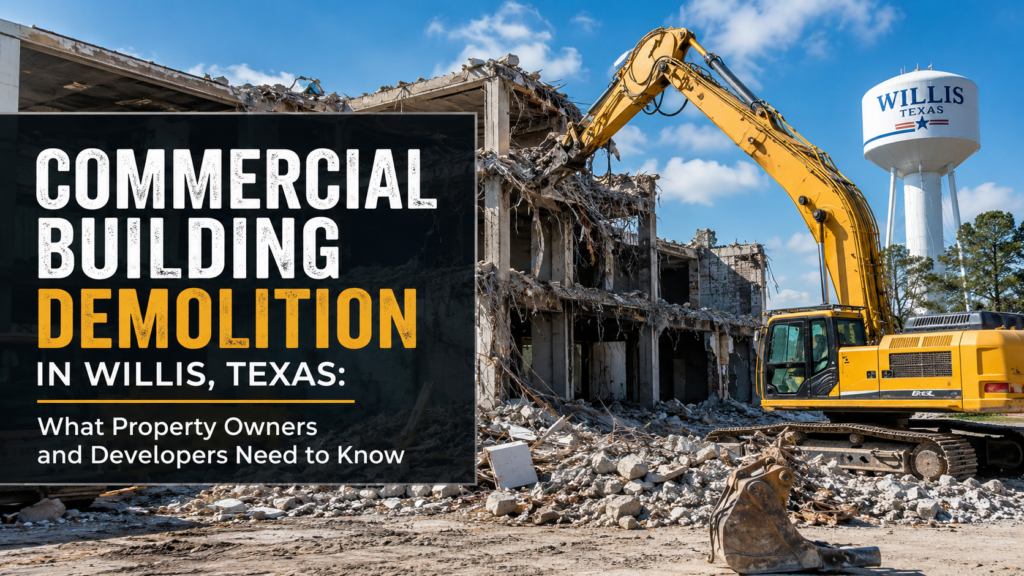
Willis, Texas has evolved significantly from its historical roots as a small community north of Conroe. The town’s position on Interstate 45 the major corridor connecting Houston to Dallas combined with its proximity to Lake Conroe and the expanding residential communities of northern Montgomery County, has drawn increasing commercial investment. As new commercial development arrives, older commercial buildings retail strips, warehouses, small office buildings, agricultural commercial structures, and aging service facilities periodically need to be removed to make way for redevelopment, property repositioning, or site improvement. Commercial Building Demolition Willis involves a different level of complexity than residential teardown, and understanding that complexity is useful for any property owner or developer planning a commercial project.
How Commercial Demolition Differs from Residential Demolition
The fundamental process of commercial demolition systematic mechanical teardown, debris removal, and site clearance shares certain elements with residential demolition. But commercial structures present a range of differences in scale, structural complexity, materials, and regulatory requirements that make commercial demolition a distinct category of work.
Scale is the most immediately obvious difference. Commercial buildings in Willis range from small roadside retail buildings of a few thousand square feet to larger warehouse and agricultural commercial structures that can span tens of thousands of square feet. Larger structures require more powerful equipment, larger debris handling capacity, and more careful demolition sequencing to manage the volume of material generated.
Structural systems in commercial buildings often differ significantly from residential construction. Where most Willis-area homes are wood-frame, commercial buildings may be masonry bearing wall construction, tilt-wall concrete (a very common commercial construction type throughout Texas), pre-engineered metal building construction (extremely common for warehouses, agricultural commercial, and light industrial uses in Montgomery County), or combinations of structural systems. Each of these requires different approaches to demolition tilt-wall concrete panels, for example, must be carefully toppled in a planned sequence to avoid uncontrolled collapse, and pre-engineered steel building systems have specific disassembly considerations tied to their bolted connections and cable bracing systems.
Hazardous material profiles in commercial buildings reflect the activities conducted within them. Even general commercial buildings retail stores, offices, restaurants may contain asbestos in floor tile, ceiling tile, pipe insulation, and joint compound if they were constructed before 1980. Commercial buildings with industrial or process histories may contain additional regulated substances including PCBs in electrical transformers and capacitors, petroleum contamination in floor drains and soil, and other process-specific residues. Pre-demolition environmental assessment is a critical step in commercial demolition that ensures all regulated materials are properly identified and addressed before structural work begins.
Pre-Demolition Requirements for Commercial Buildings in Willis
The City of Willis demolition permit requirement applies to commercial structures as well as residential ones. Commercial demolition typically involves additional regulatory steps beyond the basic permit because of the scale and the potential hazardous material exposure profile.
TCEQ asbestos survey requirements are explicit for public buildings being demolished in Texas, and commercial buildings fall within this category. A licensed asbestos inspector must survey the building before demolition, and any regulated asbestos-containing materials found must be abated by a licensed asbestos abatement contractor before structural demolition begins. TCEQ requires notification of asbestos abatement activities, and proper documentation of the survey and abatement must be maintained.
Utility disconnections for commercial buildings can be more complex than residential, because commercial buildings often have more extensive utility service connections. Three-phase electrical service, natural gas service for HVAC or process equipment, water and sewer connections, telecommunications infrastructure, and fire suppression systems all require proper disconnection and decommissioning before demolition. For buildings with fire suppression systems, the system must be properly drained and the connections capped by a licensed fire protection contractor.
If the commercial property has known or suspected environmental contamination based on its use history a Phase I Environmental Site Assessment (ESA) and potentially a Phase II investigation may be required before demolition can proceed. This is particularly relevant for former gas stations, dry cleaners, auto repair facilities, agricultural chemical storage facilities, and other commercial uses with identified contamination pathways.
Demolition Methods for Commercial Buildings in Willis
Mechanical demolition with excavators is the standard approach for most commercial building demolitions in the Willis area. The specific equipment and technique depend on the construction type. For metal buildings which are ubiquitous in the commercial and agricultural commercial landscape of Montgomery County excavators with demolition shear or grapple attachments are highly efficient at collapsing and processing the steel structure. The resulting steel is typically separated for scrap metal recycling, which has meaningful economic value and partially offsets demolition costs.
For masonry commercial buildings, hydraulic breaker attachments on excavators efficiently break through block and brick construction. Tilt-wall concrete commercial buildings require careful sequencing the demolition contractor plans the sequence in which panels are toppled to avoid uncontrolled failure and to manage the direction of fall and resulting debris footprint. This planning step is important for safety and for efficient debris processing.
For larger commercial demolition projects where multiple structures or a complex of buildings is being cleared, the demolition may be phased to manage debris accumulation and hauling logistics. Debris from one portion of the project is cleared before demolition of the next section begins, keeping the site manageable and allowing trucks to access the work area continuously.
Debris Management in Commercial Demolition
Commercial demolition generates several distinct material streams that are handled differently. Structural steel from metal buildings and structural steel components from other building types is separated and recycled through scrap metal channels the scrap value of commercial-scale steel quantities can be significant and partially offsets demolition and hauling costs. Concrete from slab floors, foundations, tilt-wall panels, and masonry construction is crushed and recycled as aggregate.
Wood from any wood-framing components, roofing decking, or interior construction is either hauled to disposal facilities or, where burn permits allow in rural Montgomery County locations, burned on site. Roofing materials particularly asphalt shingle roofing, built-up roofing, and TPO or EPDM membrane roofing must be properly disposed of at facilities accepting these materials. Mechanical, electrical, and plumbing fixtures and equipment that have value are often separated for resale or recycling before demolition begins.
Site Preparation After Commercial Demolition in Willis
After a commercial building is demolished and debris cleared, the site preparation work that follows is as important as the demolition itself. The Willis permit code requires that sites be graded to drain after demolition. For commercial redevelopment projects, the post-demolition site preparation scope is typically guided by the engineering and architectural plans for the new development.
Commercial sites often require more extensive post-demolition earthwork than residential lots. Underground infrastructure floor drains connected to grease traps, underground storage tanks, utility tunnels, and process sumps must all be identified, decommissioned, and properly removed or abandoned in place according to applicable regulations. The cleared site must be graded to the design elevations established by the civil engineer for the new project, and erosion control must be implemented to prevent sediment from leaving the site during the interval between demolition and new construction.
Common Questions About Commercial Building Demolition in Willis
What types of commercial buildings are most commonly demolished in Willis? Pre-engineered metal buildings (warehouses, agricultural facilities, service facilities) and older masonry retail or office buildings are the most frequent commercial demolition subjects in the Willis area. Mobile commercial buildings and older manufactured commercial structures also represent a regular demolition category.
Is an asbestos survey required before commercial demolition in Texas? Yes. TCEQ regulations require asbestos surveys of public buildings which includes commercial structures before demolition. A licensed inspector surveys the structure, and any regulated asbestos-containing materials must be professionally abated before structural demolition begins.
Can commercial demolition steel be recycled? Yes, and it typically is. Structural steel from commercial building demolitions has scrap value that varies with market conditions. Separating and recycling steel reduces hauling and disposal costs and can partially offset the overall demolition project cost.


